Business plan — restructured addendum
LastStop Business Plan
One brand, a Village behind it: the commercial founding-partner route, an empty replacement-cost evidence schedule, a 24-month model skeleton, and the full pitch deck as the final chapter.
Not an offer. This document describes a proposed founding-partner business arrangement, not an offer to sell or a solicitation of an offer to buy any security. Any terms described are illustrative or proposed until set out in a signed Deliverables and Rights Schedule and definitive partner agreement. Figures shown are targets and illustrations, not guarantees or projections of results, and are forward-looking statements subject to change based on execution, market conditions and factors outside LastStop's control. Selected-brand availability, cohort pricing and proposal terms are management selection policy and may change for unaccepted terms; accepted terms are not changed retroactively.
Part 01 of 14
Executive Summary
LastStop is a healthcare-brand launch platform. The commercial offer is one selected brand, with a Village of 20 shared operating capabilities behind it. The Village is a grouping of capabilities described in this plan. It is not a claim that each module is live, included, or delivered until a signed Deliverables and Rights Schedule says so. Provider coordination and pharmacy coordination remain prospective until signed [F24].
The founding-partner offer is for hands-on operators who will launch and run their own healthcare brand. A founding partner contributes operating time and proposed capital. LastStop contributes a selected brand, defined platform access, included Village services, and launch support, all as specified in the signed schedule. This is not a passive placement. Applications confer no reservation until a contract is accepted.
This document covers positioning, the commercial partner route, the twenty Village modules, the rights schedule, your contribution and the license, illustrative economics, an empty 24-month model skeleton, the replacement-cost evidence schedule still to be filled, the founding proposal window, launch gates, risks, and how this addendum sits next to the original September plan.
Part 02 of 14
Positioning
Build your healthcare brand with a Village behind you.
A limited founding cohort for hands-on brand partners, with shared launch systems and clearly defined responsibilities.
The September plan was written as a financing structure. That architecture remains in the original plan and in the private appendix. The commercial route is a different presentation of the same operating system. We are offering a limited founding cohort of hands-on brand partners. Each selected partner launches one selected brand. LastStop stands behind that brand with shared launch systems and a written assignment of duties.
The reframe is terminology and audience, not a change to legal classification. A passive revenue share in something we operate is a security. A branded, supported business system sold for a fee follows the FTC Franchise Rule pattern. Counsel decides the exemption. A hands-on title does not, by itself, make BrandCo ownership or profit participation a non-security. Every term not yet in a signed agreement is proposed or illustrative in the sentence that states it.
The public commercial route presents only the selected-brand partnership. Parent-layer ownership, retained brands, bundle vehicles, and the Deployment Company raise stay in internal documents and in the private appendix.
Part 03 of 14
Commercial Partner Route
A founding partner is a hands-on operator. The proposed contribution has two parts: operating time and proposed capital. Operating time means the partner can staff the duties the signed schedule assigns — launch decisions, local execution, and the authority the schedule names. Proposed capital follows the three-rung table in Your Contribution and the License. The Partner briefing collects operating experience, available time, capabilities, proposed capital, and preferred responsibilities. Privacy acknowledgement is required. Marketing consent is separate and optional.
An application is a non-binding indication of interest. It is not a reservation, not an acceptance of funds, and not a contract. No deposits are collected during interest collection. Accepted terms never change.
LastStop delivers, if a contract is accepted, a selected brand and the services the signed Deliverables and Rights Schedule lists. The public claim we will use until a replacement-cost ledger exists is this: launch with a brand and shared operating infrastructure instead of assembling every component independently. Founding partners receive the deliverables, service access, and launch support specified in their agreement.
Provider coordination and pharmacy coordination are prospective until signed [F24] [F109]. No vendor is named in this document [F130]. HealthOS and the private parent / protected IP layer are not part of this offer [F12] [F22] [F110]. Access to shared infrastructure never conveys ownership of the platform or of other brands.
Every commercial term in this chapter is proposed until it appears in a signed agreement.
The Deliverables and Rights Schedule is the signed document that states what the partner actually receives. Public copy may summarize it. The schedule, not this plan, controls. Its twelve elements are:
- selected brand and domain rights
- BrandCo ownership or contractual participation — the signed schedule states which
- duration and scope of platform access
- included Village services
- launch deliverables and acceptance tests
- required partner duties and authority
- recurring fees
- service limits
- support term
- third-party costs
- additional funding obligations
- termination and transition rights
Part 04 of 14
The Village — 20 Shared Capabilities

The Village is twenty shared operating capabilities grouped around one centre node: the selected brand, with defined rights, services, and operating responsibilities. The list is a grouping of capabilities described in the plan. It is not a claim that each module is live or included.
Each module carries six fields: purpose, delivered status, included tier, recurring fee, dependency, and evidence date. None of those fields is prefilled "live." Included tier, recurring fee, and delivered status are proposed until the signed schedule states them.
Brand and site
01 Brand identity and assets. Holds the selected brand's visual and verbal system so the site, ads, and documents use one identity.
02 Website and conversion funnels. Provides the public site and conversion paths that collect interest and move qualified applicants into intake.
Clinical and operations
03 Intake and eligibility. Collects the information needed to decide whether a prospective patient can proceed, before clinical work begins.
04 Provider coordination. Routes eligible cases to contracted clinicians for the selected brand. Integrations are prospective until signed [F24].
05 Pharmacy coordination. Routes prescribed products through contracted pharmacies for the selected brand. Integrations are prospective until signed [F24].
06 Payments and reconciliation. Collects patient payments and matches them to orders and refunds so BrandCo books can be closed.
07 CRM and lead management. Stores prospect and patient-account records for the selected brand and tracks status through the funnel.
08 Patient support workflows. Handles questions, issues, and case follow-up after a patient is in the program.
09 Refill and follow-up workflows. Runs the repeat-order and scheduled-follow-up steps that keep an active patient on protocol where clinically appropriate.
Growth
10 Email and SMS lifecycle. Sends the permitted email and text sequences for onboarding, refill reminders, and service notices.
11 Media buying operations. Places and manages the paid media funded by the proposed media commitment.
12 Creative and ad production. Produces the ad and landing creative used in those media placements.
15 Analytics and attribution. Reports where inquiries and first-time paying customers came from, within the limits of the tracking that is actually installed.
16 A/B testing and CRO. Tests page and offer variants against conversion. It does not prove a revenue target.
Compliance and reporting
13 ClaimRight review workflow. Reviews public claims against the evidence file before they are used in ads or on the site.
14 Consent and evidence records. Stores consent artifacts and the evidence supporting claims, kept separate from clinical records as required.
17 Partner reporting. Produces the periodic operating reports the signed schedule requires.
18 Launch project management. Sequences the launch tasks, owners, and acceptance tests for the selected brand.
19 Vendor and integration support. Coordinates the third-party connections the selected brand needs. No vendor is named here [F130].
20 Shared operating playbooks. Holds the written procedures the operator and LastStop both follow for the included services.
Part 05 of 14
Rights Schedule Summary
The Deliverables and Rights Schedule is a signed document. This section is a public summary of proposed elements. It is not the schedule.
The partner receives rights in a selected brand and its domain, as the schedule defines them. Those rights cover the brand identity, the consumer-facing domain, and the public materials that use them. They do not cover the platform, other brands, or parent-layer intellectual property.
BrandCo ownership or contractual participation are both possible — the signed schedule states which. This plan does not choose between them. A title in this briefing does not convert one into the other.
Duration and scope of platform access are written terms, not implied by payment. The schedule states the start, the end, and which Village modules the partner may use. Access that is not listed is not included.
Included Village services are listed by module, with delivered status and recurring fee beside each included item. Those fields are proposed until the schedule is signed. A module named in this plan is not, by that naming, an included service.
Launch deliverables come with acceptance tests. A deliverable is not complete because work started. The schedule names the test for each deliverable. Until the test is met, the item remains open.
Partner duties and authority are listed so each party knows who decides what. The partner is expected to supply the operating time and decisions the schedule assigns. LastStop is expected to supply the included services and launch support the schedule assigns. Authority that is not written is not granted.
Recurring fees, service limits, and the support term are stated as numbers and dates in the schedule, not as slogans. Service limits include volume, hours, channels, and any cap the schedule names. The support term is a dated window. It is not a lifetime grant.
Third-party costs — including provider, pharmacy, payments, media, and similar categories — are identified as to who pays. No vendor is named in this document [F130]. Additional funding obligations, if any, are written before operations begin. An unsigned extra-capital expectation is not an obligation.
Termination and transition rights state what happens to the brand, the data the partner is entitled to, and the platform access when the relationship ends. The schedule, not this summary, controls that exit.
Access to shared infrastructure never conveys ownership of the platform or of other brands.
Part 06 of 14
Your Contribution and the License
The commercial route publishes only this three-rung founding proposal table. All figures below are proposed, not plan terms, and not a signed obligation.
| Proposed contribution | Media commitment (ring-fenced) | License fee (LastStop) |
|---|---|---|
| $50,000 | $50,000 | Included in the entry contract |
| $75,000 | $50,000 | $25,000 |
| $100,000 | $50,000 | $50,000 |
The proposed $50,000 media commitment is ring-fenced as media, for the partner’s brand. It is not a pool for unrelated expenses [F104]. A partner may commit more than $50,000 to advertising at any time. The license fee is LastStop’s price for the license, shown as a price — not a budget, and not itemized by use.
More capital does not buy more ownership, lifetime services, parent rights, or exclusivity. Launch deliverables are listed in the signed Deliverables and Rights Schedule.
The five-tier tiered pricing structure used in the September financing plan is not part of this commercial table. It is not part of the founding-partner route.
Part 07 of 14
Economics Bridge (Illustrative)
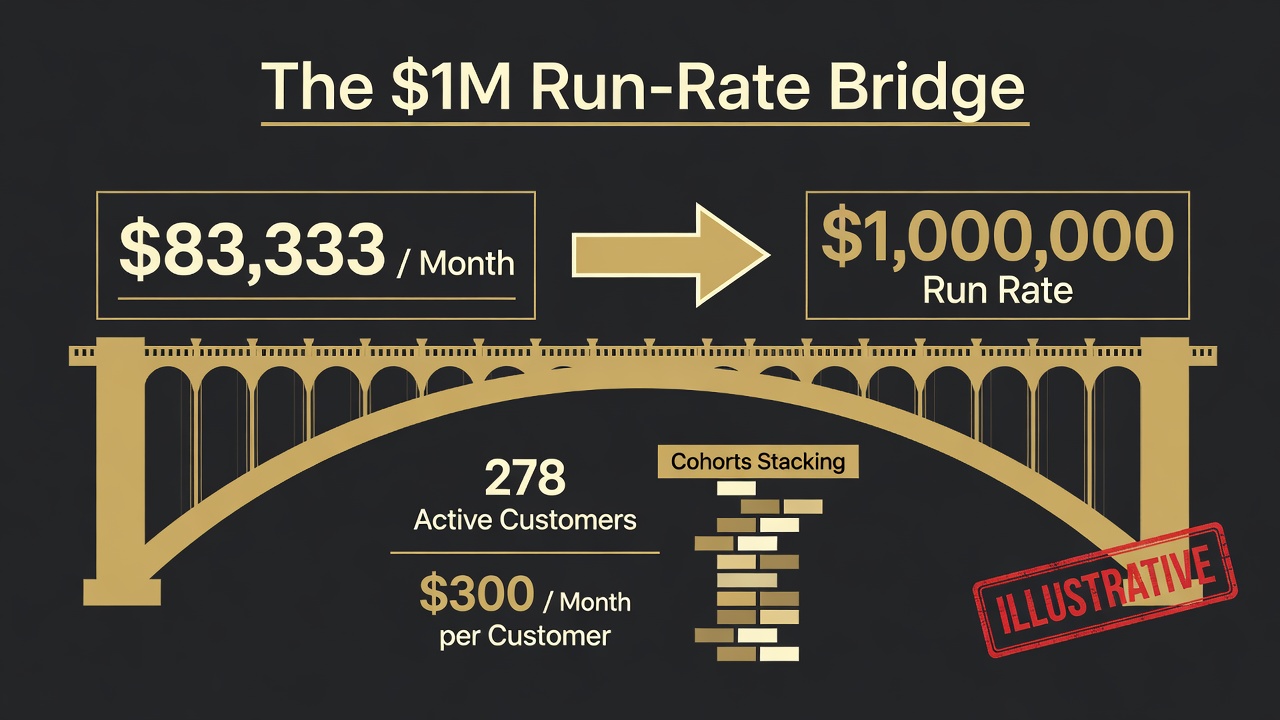
The arithmetic in this chapter is illustrative. It uses hypothetical inputs. It is not a forecast, not a target, and not first-year results [CANON §2].
An illustrative $1,000,000 run rate equals $83,333 per month [CANON §2]. At an illustrative $300 of recognized monthly revenue per active customer, that run rate implies about 278 active customers [CANON §2]. These figures are illustrative arithmetic on hypothetical inputs, labeled as such.
A proposed $50,000 media commitment, at illustrative customer-acquisition costs of $150, $250, and $400, implies about 333, 200, and 125 first-time paying customers before churn and capacity [CANON §2]. That is a count of first-time paying customers, not a count of customers still active twelve months later.
A year of acquisitions is not twelve months of active customers. Monthly cohorts, refunds, and attrition have to be built before anyone treats the figure as a book. Run rate at exit is not first-year revenue. BrandCo revenue follows its contractual and accounting role, not total patient billings. GMV is not revenue [F105].
No period-by-period revenue, cost, or margin projection exists in the package [F127].
Part 08 of 14
Profit Illustration
This chapter is illustrative. It is not a distribution policy and not a term [CANON §2].
At an illustrative $1,000,000 of recognized revenue and illustrative all-in margins of 10 percent, 20 percent, and 30 percent, BrandCo operating profit would be $100,000, $200,000, and $300,000 [CANON §2]. A hypothetical 49 percent share of those amounts would be $49,000, $98,000, and $147,000 before reserves, adjustments, and taxes [CANON §2].
The 49 percent figure is the earlier proposal, not a documented term, and is not adopted. This plan uses it once, in this illustration only. The signed schedule states the actual participation, if any.
A $200,000 distribution at 20 percent margin and that same hypothetical 49 percent share would need about $2.041 million of recognized revenue [CANON §2]. Compensation, capital repayment, taxes, and distributions are separate lines. They are not the same cash.
Monthly break-even, when a model exists, is fixed cost plus acquisition spend, divided by unit contribution. That model has not been filled [F127] [F136].
Part 09 of 14
24-Month Model Skeleton
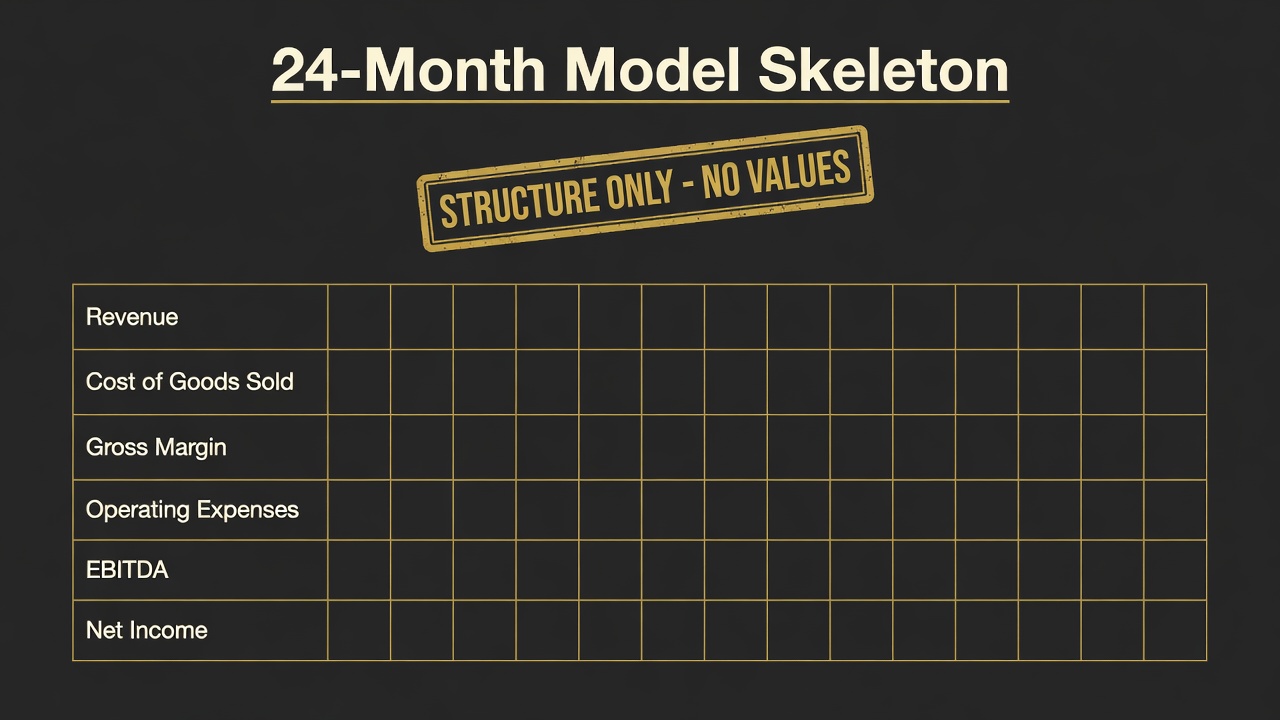
No period-by-period model exists in the package [F127]. This chapter is a row list only. No values are inserted.
A monthly BrandCo model, when built from observable evidence, would track these rows, grouped by function:
Cash position
- opening cash
- funds by payee
- closing cash
Acquisition
- media
- CAC
- new customers
Revenue and retention
- active cohorts
- churn
- recognized revenue
Costs
- clinical and pharmacy costs where borne
- support
- payment fees
- refunds
- Village fees
- founder compensation
Capital
- reserves
- capex
BrandCo profit and loss is kept separate from DeploymentCo profit and loss. Intercompany amounts are eliminated on consolidation. Downside, base, and upside cases, when written, must come from observable evidence. Values are not inserted to hit a value estimate.
Part 10 of 14
Replacement-Cost Evidence Schedule
The figures "$500,000" and "$1M site value" are not established. They are not used as claims in this plan.
The allowed claim today is: shared infrastructure access instead of assembling every component independently. The stronger claim — a documented estimated replacement cost with scope and date beside it — becomes available only after this schedule is filled with dated comparable quotes and overlap deductions. Do not assign the whole shared-platform cost to each brand.
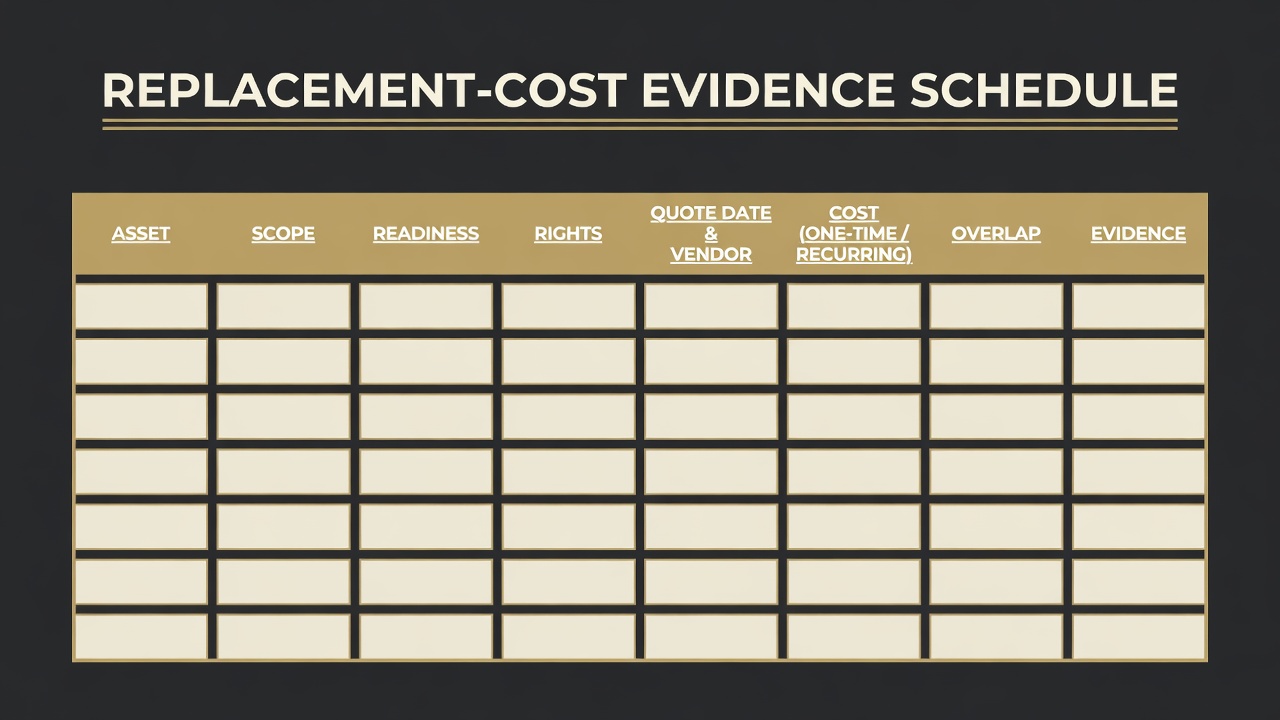
This ledger is empty. Column headers only:
| Column | What it records |
|---|---|
| Asset | The named capability or deliverable |
| Scope | What is in, and what is out |
| Readiness | Designed, integrated, launch-ready, or operating, with no prefilled live badge |
| Rights | What the partner is actually granted versus what stays with the platform |
| Quote date | Date of the comparable quote |
| Vendor | Category only in public materials; names are withheld here [F130] |
| One-time build cost | Efficient current replacement, not historical spend |
| Recurring cost | Recurring plans and ongoing human services, listed separately |
| Overlap adjustment | Amount already counted in another row, deducted |
| Evidence | The quote, invoice, or work product attached |
Usable deliverables, work in progress, planned capabilities, recurring plans, and ongoing human services are separate rows. Value is taken at current efficient replacement methods, not at a hoped-for site price.
Part 11 of 14
Founding Proposal Window
We are preparing one or two founding places through a private, non-binding application and proposal window. The close date is published only once it is decided. The minimum media commitment is the proposed $50,000 rung in the commercial cash table. Extra contribution does not change ownership, lifetime services, parent rights, or exclusivity.
The window has no public bidding leaderboard, no fabricated competing offers, and no automatic highest-bid award. Sites are offered in cohort order. Within a cohort, the first qualified application is considered. We may decline applicants and may withdraw unopened inventory [F23]. Accepted terms are never changed retroactively [F33] [F111].
Proposed selection weights:
| Criterion (proposed) | Weight (proposed) |
|---|---|
| Execution ability | 35% |
| Strategic contribution | 25% |
| Financial capacity | 25% |
| Working fit | 15% |
Applications confer no reservation until a contract is accepted. No deposits are collected during interest collection. Offer versions and the rationale for acceptance or decline are recorded. Accepted terms never change.
Part 12 of 14
Launch Gates and Readiness
Site cards on the commercial route state readiness honestly. The ladder is:
- designed — evidence: to be attached
- integrated — evidence: to be attached
- launch-ready — evidence: to be attached
- operating — evidence: to be attached
A designed brand is not an operating business [F103]. Provider and pharmacy integrations remain prospective until signed [F24].
The current portfolio has 20 numbered sites [F25]. Of those 20 sites, 6 are available, 1 is reserved, and 13 are retained by management [F26]. Only released brands appear on the public route: the 6 available and the 1 reserved. The 13 retained sites stay private. Ten incubation and reserve brands are counted and are never individually named [F19]. No state, jurisdiction, or consumer-facing brand name is given for any site in this pack; each is identified only as Site 01 through Site 20 [F125].
A later launch after the founding cohort is readiness-gated and cash-gated. It is not automatic because a site exists on an internal list.
Part 13 of 14
Risks
The fourteen risks below are the package's own list, verbatim [F102]–[F115]. Each item is followed by the control LastStop uses.
- Value estimate counts assets the issuer does not own. Addressed by keeping parent-layer assets and HealthOS out of the commercial offer, and by requiring the replacement-cost schedule before any replacement-cost figure is used [F12] [F22].
- Twenty sites are presented as operating businesses when they are only designed brands. Addressed by the designed / integrated / launch-ready / operating ladder and by requiring attached evidence before a site is labeled operating [F103].
- $50K is described as ad spend but is consumed by unrelated expenses. Addressed by ring-fencing the proposed $50,000 as a media commitment and by showing the license fee as a price, not a fund with stated uses [F104].
- GMV is presented as revenue. Addressed by using recognized revenue in every illustration and by stating that BrandCo revenue follows its contractual and accounting role, not total patient billings [F105].
- One-time license or launch fees are presented as ARR. Addressed by keeping one-time fees, recurring fees, and run-rate illustrations on separate lines [F106].
- Scarcity is fabricated or inventory status is manually manipulated to create urgency. Addressed by publishing released-brand availability only, by not running a public bidding leaderboard, and by treating inventory status as a management decision rather than a countdown [F26] [F33] [F107].
- "First come" conflicts with a discretionary right to reject buyers. Addressed by stating the proposed selection weights, by stating that we may decline applicants, and by not treating "first come" as an automatic award [F23] [F33] [F108].
- Provider/pharmacy dependencies are undisclosed. Addressed by stating that provider and pharmacy integrations are prospective until signed, and by naming no vendor in this document [F24] [F109] [F130].
- A reader can infer that future HealthOS/IP is included when it is not. Addressed by stating that HealthOS and the private parent / protected IP layer are not part of the founding-partner offer [F12] [F22] [F110].
- Terms change after the prospect has committed. Addressed by recording offer versions and by stating that accepted terms never change [F111].
- Site partners receive inconsistent side deals. Addressed by using one signed Deliverables and Rights Schedule per selected brand and by not changing accepted terms [F112].
- Public advertising conflicts with the selected securities exemption. Addressed by keeping these commercial founding-partner materials separate, and by not treating the commercial chapters as an offer to sell securities [F113] [F124].
- No documented method exists for dividing shared costs between sites. Addressed by requiring the signed schedule to state recurring fees, third-party costs, and additional funding obligations before operations begin [F114].
- Partner-facing reporting cannot reconcile to accounting. Addressed by keeping BrandCo profit and loss separate from DeploymentCo profit and loss, eliminating intercompany on consolidation, and tying partner reporting to the schedule [F115].
Part 14 of 14 — final chapter
The Pitch Deck (full, 15 slides)
The full founding-partner pitch deck follows, reproduced here as the plan's final chapter. See also the standalone deck presentation and its PDF.
Not an offer. This document describes a proposed founding-partner business arrangement, not an offer to sell or a solicitation of an offer to buy any security. Any terms described are illustrative or proposed until set out in a signed Deliverables and Rights Schedule and definitive partner agreement. Figures shown are targets and illustrations, not guarantees or projections of results, and are forward-looking statements subject to change based on execution, market conditions and factors outside LastStop's control. Selected-brand availability, cohort pricing and proposal terms are management selection policy and may change for unaccepted terms; accepted terms are not changed retroactively.