Slide 01 / 15 — LastStop: One brand. A Village behind it.
Cover
One brand. A Village behind it.
A limited founding cohort for hands-on brand partners, with shared launch systems and clearly defined responsibilities. LastStop is the healthcare-brand launch platform behind the selected brand.
Slide 02 / 15 — LastStop: One brand. A Village behind it.
Problem
A healthcare brand is many projects at once.
- Intake, provider network, and pharmacy routing each start from zero.
- Compliance, media buying, CRM, and reporting are separate projects.
- Building them alone is a stack of projects, not a launch.
Slide 03 / 15 — LastStop: One brand. A Village behind it.
The Village

Shared modules sit behind every selected brand.
The Village is 20 shared capability modules behind every selected brand — a grouping, not a claim each module is live or included. Representative: brand identity and assets; website and conversion funnels; intake and eligibility; provider coordination; pharmacy coordination; CRM and lead management; media buying operations; ClaimRight review. The full 20 appear on the Village diagram.
Sources: 20 capability modules (CANON §3 grouping, not a live or included claim); distinct from the 20-site count [F19] [F25]
Slide 04 / 15 — LastStop: One brand. A Village behind it.
One brand
The partner operates one brand, not the platform.
A founding partner selects and operates one brand. LastStop stays behind it with the shared systems. The partner receives selected-brand and domain rights, plus BrandCo ownership or contractual participation — the signed schedule states which. Access never conveys ownership of the platform or of other brands.
Slide 05 / 15 — LastStop: One brand. A Village behind it.
What you get
Rights and services are named in a signed schedule.
- Selected brand and domain rights.
- BrandCo ownership or contractual participation — the signed schedule states which.
- Duration and scope of platform access, and included Village services.
- Launch deliverables and acceptance tests.
- Recurring fees, service limits, support term, termination and transition rights.
Slide 06 / 15 — LastStop: One brand. A Village behind it.
What you do
This is a hands-on operating role.
Required partner duties and authority sit in the signed schedule: a hands-on operating role, not passive capital. The partner brings time, operating decisions inside that authority, and market execution. LastStop keeps the platform, other brands, and shared-system ownership. Applications confer no reservation until a contract is accepted.
Slide 07 / 15 — LastStop: One brand. A Village behind it.
Cash table
Three proposed rungs: media, plus a license fee at two of them.
- $50,000 proposed = $50,000 media [F27]. Entry contract, no separate license fee.
- $75,000 proposed = $50,000 media [F27] + $25,000 license fee.
- $100,000 proposed = $50,000 media [F27] + $50,000 license fee.
- The license fee is LastStop’s price for the license. More contribution does not buy more rights or exclusivity.
Sources: $50,000 media [F27]; $50,000 / $75,000 / $100,000 proposed rungs (CANON §2; not a fact-pack cohort price); $0 / $25,000 / $50,000 license fee (CANON §0c)
Slide 08 / 15 — LastStop: One brand. A Village behind it.
Economics bridge
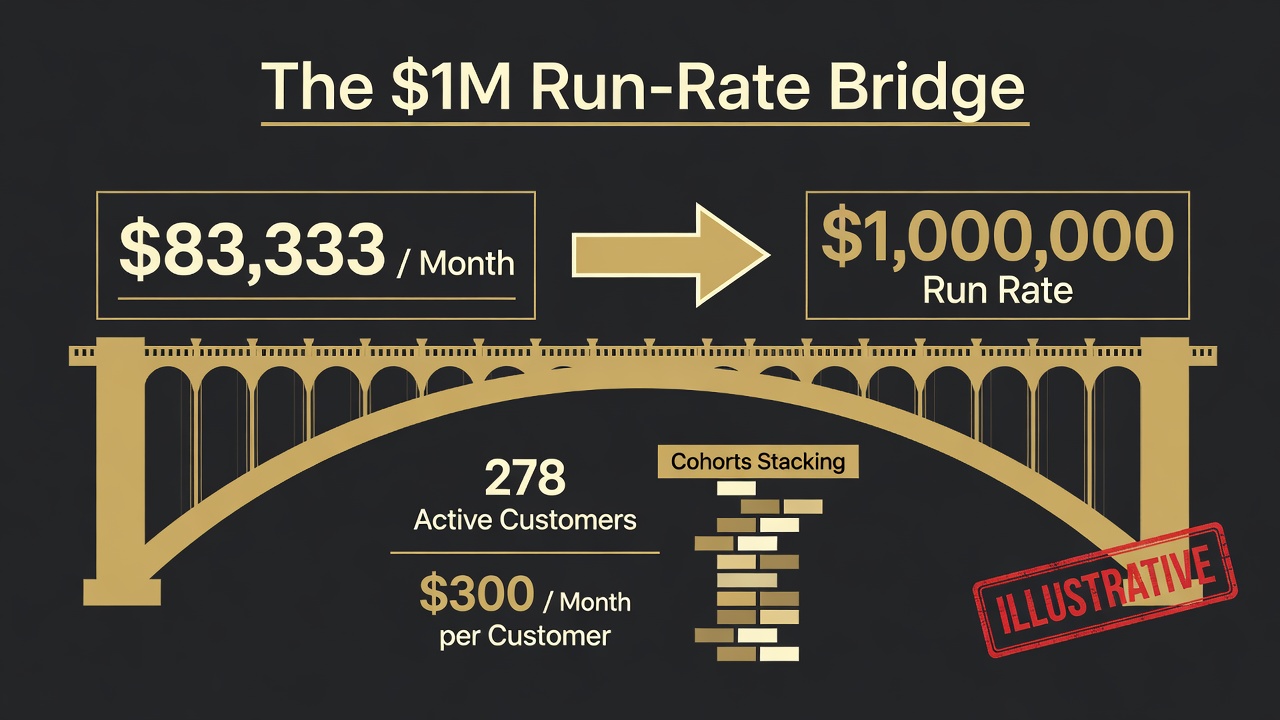
Illustrative math from media to a run rate.
Illustrative arithmetic on hypothetical inputs: a $1,000,000 run rate equals $83,333 per month; at $300 recognized monthly revenue per active customer, about 278 active customers. $50,000 media [F27] at illustrative CAC $150 / $250 / $400 is about 333 / 200 / 125 first-time paying customers before churn. Run rate is not first-year revenue.
Sources: $1,000,000; $83,333; $300; 278; CAC $150 / $250 / $400; 333 / 200 / 125 — CANON §2 illustrative arithmetic (no F-tag). $50,000 media [F27]
Slide 09 / 15 — LastStop: One brand. A Village behind it.
Readiness ledger
Only released brands appear, each with a status.
Each released brand is labeled designed, integrated, launch-ready, or operating, with evidence. The public route shows released brands only: 6 available [F26], 1 reserved [F26]. Retained inventory stays private. Designed is not operating. Provider and pharmacy integrations are prospective until signed.
Sources: 6 available, 1 reserved [F26]
Slide 10 / 15 — LastStop: One brand. A Village behind it.
Selection
One or two places, scored on four proposed weights.
A private, non-binding application and proposal window for one or two proposed founding places. Proposed weights: execution ability 35%, strategic contribution 25%, financial capacity 25%, working fit 15%. Applications confer no reservation until a contract is accepted. No deposits during interest collection.
Sources: one or two places; 35% / 25% / 25% / 15% proposed weights (CANON §5; no F-tag)
Slide 11 / 15 — LastStop: One brand. A Village behind it.
Timeline
Five phases, in order, with no promised dates.
Application, then review, then a written proposal, then a signed agreement, then launch. No close date is published until it is decided. Applications confer no reservation until a contract is accepted. This is a phase sequence, not a dated plan.
Slide 12 / 15 — LastStop: One brand. A Village behind it.
Risks
Five material risks, each with a named control.
- Designed brands presented as operating — released brands carry a readiness label [F103].
- Provider and pharmacy dependencies — prospective until signed [F109].
- Media described as ads then spent elsewhere — $50,000 media is ring-fenced [F104] [F27].
- Shared systems inferred as owned IP — access is not ownership [F110].
- Terms change after commitment — accepted terms never change [F111].
Sources: [F103] [F109] [F104] [F110] [F111]; $50,000 media [F27]; drawn from the 14 risks [F102]–[F115]
Slide 13 / 15 — LastStop: One brand. A Village behind it.
Team
Named roles; unnamed management, by early-stage discretion.
Operations lead
Launch project management: sequencing tasks, owners and acceptance tests for the selected brand.
Compliance lead
ClaimRight review workflow: checks public claims against the evidence file before use in ads or on the site.
Growth lead
Media buying operations and creative production for the proposed media commitment.
Management is unnamed [F23] [F129]. Early-stage discretion: unnamed management can withdraw unopened inventory, decline applicants, and stop releasing brands. Vendors appear only as categories [F24].
Sources: unnamed management [F23] [F129]; vendors as categories [F24]
Slide 14 / 15 — LastStop: One brand. A Village behind it.
The ask
Bring capital, time, and operating experience.
LastStop is asking a founding partner for a proposed capital tier of $50,000, $75,000, or $100,000, hands-on time against scheduled duties, and operating experience. If selected: a written proposal, then a signed agreement, then launch. Applications confer no reservation until a contract is accepted.
Sources: $50,000 / $75,000 / $100,000 proposed rungs (CANON §2); $50,000 media [F27]
Slide 15 / 15 — LastStop: One brand. A Village behind it.
Next step
Partner briefing, then apply for founding partnership.
Start at Partner briefing, then Apply for founding partnership: operating experience, available time, capabilities, proposed capital, and preferred responsibilities. Privacy acknowledgement is required; marketing consent is separate and optional.
Legal
Not an offer. This document describes a proposed founding-partner business arrangement, not an offer to sell or a solicitation of an offer to buy any security. Any terms described are illustrative or proposed until set out in a signed Deliverables and Rights Schedule and definitive partner agreement. Figures shown are targets and illustrations, not guarantees or projections of results, and are forward-looking statements subject to change based on execution, market conditions and factors outside LastStop's control. Selected-brand availability, cohort pricing and proposal terms are management selection policy and may change for unaccepted terms; accepted terms are not changed retroactively.